Trinet Stereo GS
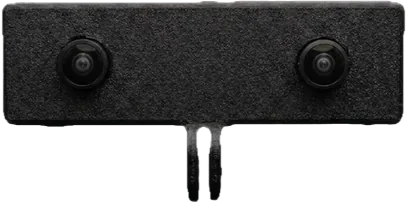
Trinet Stereo GS is the global-shutter version of Trinet Stereo. Every row of the image is exposed at the same instant, so fast hand, tool and head motion is captured without the skew and wobble of a rolling shutter. Everything else — two eyes 70 mm apart, motion data, audio, factory calibration, the app and the SDK — works exactly like Trinet Stereo.
Specifications
| Cameras | 2, baseline 70 mm |
| Sensors | 2.3 MP global shutter, recorded at 1920×1080 per eye |
| Frame rate | 30 fps |
| Codec | H.264 (default) or H.265 for card recordings; live USB stream is H.264 |
| Card bitrate | Constant 10 Mbps per eye |
| Storage | About 10 GB per hour (both eyes, audio and motion data) |
| Lens | Ultra-wide fisheye; effective field of view about 160° horizontal × 96° vertical per eye (from calibration) |
| Frame timing | Whole frame exposed at once; timestamped at mid-exposure |
| Motion sensing | 3-axis accelerometer (±8 g), 3-axis gyroscope (±2000 °/s) at 400 Hz; 3-axis magnetometer at about 100 Hz |
| Audio | Stereo microphones, AAC, 44.1 kHz on card recordings |
| IMU–video alignment | Sub-millisecond, hardware-timestamped |
| Recording to card | One button; no limit on take length |
| Live streaming | USB webcam mode: one 3840×1080 side-by-side stream (both eyes) to Android or a computer |
| Wireless | Multi-camera sync; recording-status broadcast readable by the Trinet app |
| Calibration | Every unit calibrated at the factory; stored on the camera and embedded in every recording |
| Weight | About 51 g |
| Power | USB-C, 5 V; a supply of 1 A or more is recommended |
How to tell it apart
In software, recordings from a Stereo GS are marked as global shutter, and their per-frame timing reports a rolling-shutter readout time of zero. The Trinet app's camera information and the SDK show the camera model. See Which camera do I have?
Recordings, heat and everything else
Recording files, button, lights, heat behaviour and kit use are the same as Trinet Stereo. Keep the firmware current: Stereo GS firmware 0.5.8 and later include important image-quality and reliability improvements.